Research model
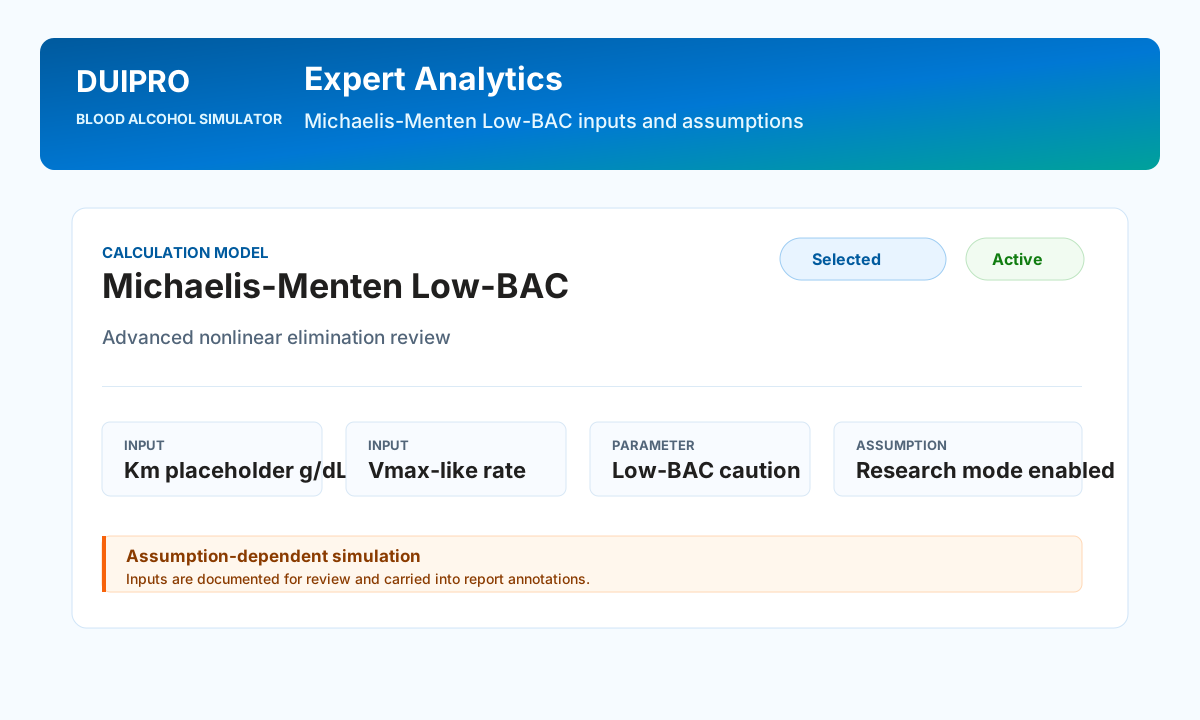
Michaelis-Menten Low-BAC
An advanced nonlinear terminal-elimination scenario for expert review, used to explore low-BAC sensitivity and explain why linear extrapolation has limits.
Purpose
Advanced low-BAC sensitivity review
The Michaelis-Menten Low-BAC model is an advanced research scenario. It is included in Expert Analytics because users asked for optional non-Widmark models, but it is not meant to replace the ordinary default workflow. It is disabled behind expert-review framing because nonlinear ethanol kinetics can be misused if the parameters and limitations are not understood.
The practical reason to expose this model is low-BAC caution. Standard linear elimination is often used in forensic alcohol calculations, but guidance warns that ordinary linear extrapolation can become problematic at very low concentrations. Michaelis-Menten style kinetics provide a way to discuss nonlinear terminal behavior, but that discussion requires specialized expertise.
DUI Professional should present the model as a scenario analysis layer. If parameter defaults are placeholders, the UI should say they are placeholders. If future expert review authenticates a parameter set, the model definition and parameter metadata can be updated. Until then, the model helps demonstrate sensitivity rather than generate a definitive result.
Scientific Background
Saturable elimination concepts
Michaelis-Menten kinetics describe processes where elimination rate depends on concentration and capacity. At higher concentrations, an eliminating system can approach a maximum rate. At lower concentrations, the rate can become concentration-dependent. Ethanol elimination in practical forensic work is often approximated linearly over common BAC ranges, but that approximation has boundaries.
The challenge is that a pharmacokinetic equation is only as useful as its parameters and assumptions. Values such as Km and Vmax-like terms may vary by population, study design, units, drinking context, and model structure. Using a number from one study without documenting its source can create false precision. DUI Professional therefore treats this model as advanced and source-sensitive.
Advanced ethanol pharmacokinetic literature emphasizes the complexity of absorption, distribution, and elimination. That variability is the reason an advanced model should not become a hidden default. The more parameter-heavy a model is, the more the report must disclose what was assumed and why.
Low-BAC interpretation is also complicated by measurement and reporting issues. When calculated values approach very low levels, rounding, analytical uncertainty, timing uncertainty, and absorption history can matter. A model that appears smooth on a chart may still be inappropriate for a legal or medical conclusion if the underlying facts do not support it.
For these reasons, the Michaelis-Menten page focuses on expert review, not automation. The model is useful for teaching why terminal elimination may not always be well represented by a single straight-line slope. It is not a license to produce ordinary courtroom-style back-calculations without a qualified expert and a defensible parameter basis.
Application Workflow
How DUI Professional exposes it
The model appears in the advanced research section. The user must affirm that advanced models are parameter-heavy and intended for expert review. This extra step is deliberate. It keeps ordinary users from selecting the model accidentally and treating the output as though it were the same kind of estimate as Standard Widmark.
The input card should show parameter names, units, default or placeholder values, editable status, and help text. If a default value is not literature-authenticated, the UI should label it as a sample placeholder. Expert Analytics explains that the placeholder is for comparison and education only.
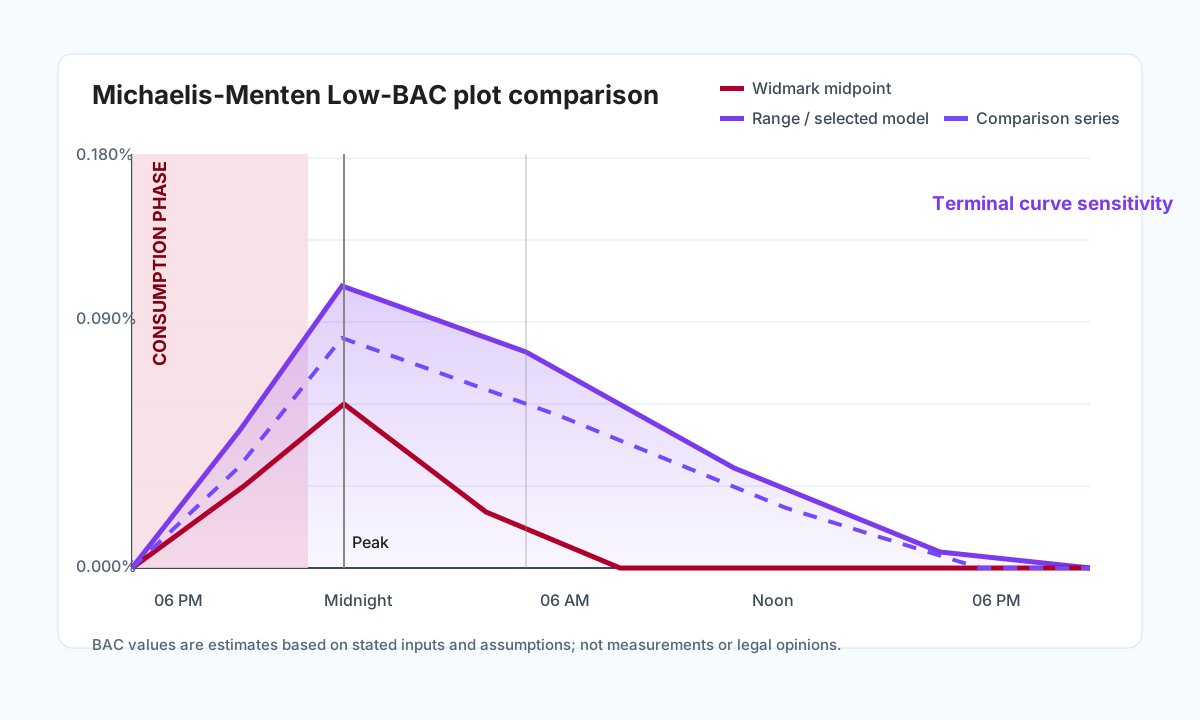
When the model is plotted, the terminal section of the curve may not look like a symmetric bell curve. BAC curves are concentration-time curves, not probability distributions. Depending on absorption assumptions and nonlinear elimination terms, the curve can rise quickly, peak, and then flatten or bend differently near low concentrations. The shape should be interpreted as model behavior, not as proof.
The model can be compared against the current midpoint and range. The chart should show a selected model line, range if available, keypoint values, and warnings. If the model is operating outside authenticated assumptions, the warning should appear both in the UI and the report appendix.
Users should keep this model out of ordinary report output unless it has been expressly selected and reviewed. The point is to support expert discussion of low-BAC and nonlinear terminal behavior, not to create a new default for all BAC simulations.
- Open Calculation Model and enable advanced research models.
- Read the warning and affirm expert-review intent before selecting Michaelis-Menten.
- Inspect every parameter value, unit, and source note before plotting.
- Compare the low-BAC tail against the current midpoint only as a scenario analysis.
- Include the appendix when exporting so placeholder or warning language is visible.
Chart Interpretation
Why the line may not look bell-shaped
A BAC curve is not expected to be a bell curve. It is a time-series concentration curve. The rising limb depends on dose timing and absorption. The falling limb depends on elimination assumptions. A Michaelis-Menten curve can show nonlinear terminal behavior, so it may look less triangular than a simple Widmark approximation and less symmetric than a probability plot.
If the curve looks unexpected, the first review step is to inspect parameters. A small Km, a large Vmax-like value, a short absorption period, or an aggressive low-BAC terminal rule can materially change the shape. DUI Professional should not hide those parameters. The user needs to see them before interpreting the line.
The model is most useful when the keypoint or report question is near low BAC. If the scenario is at moderate or high BAC, the ordinary linear range model may be easier to explain and more appropriate for many forensic reports. Expert Analytics frames Michaelis-Menten as a narrow research tool, not a universal improvement.
Warnings should be treated seriously. If the model says it is using placeholder values or requires literature review, the chart should not be cited as a final calculation. It can still help an expert explain why low-BAC extrapolation is sensitive and why a report should not overstate precision.
Audit Controls
Parameter review before use
The Michaelis-Menten page should be treated as a parameter audit before it is treated as a chart. The user should identify the Km range, the Vmax-like elimination basis, the absorption profile, the low-BAC caution threshold, and whether each value came from literature metadata, the current simulation, or a placeholder. A model with unexplained constants should not be exported as a professional conclusion.
Units matter. Literature may describe concentration in mg/100 mL, g/L, or g/dL, while the simulator reports BAC in g/dL-equivalent percent terms. A number that is correct in one unit can be wrong by an order of magnitude in another. DUI Professional therefore needs every advanced parameter to display its units and conversion basis when available.
The output should also be checked against a simple control expectation. After absorption is complete, a nonlinear terminal model should not invent ethanol dose. It should approach zero without going negative. If the curve changes mainly near low concentrations, that behavior should be visible and explainable from the parameters. If the whole curve changes dramatically, the user should inspect absorption, dose, and distribution assumptions before interpreting the result.
Because this model is advanced, the safest workflow is comparison-first. Plot it beside the Standard Widmark or ASB range output, read the difference at the keypoint, and then decide whether the distinction matters. If it does matter, expert review should address whether the selected parameters are defensible.
- Inspect Km, Vmax-like basis, absorption profile, and low-BAC warning thresholds.
- Confirm all units and any conversions before interpreting the line.
- Use the model as a comparison scenario unless expert review supports substantive use.
- Export only with warning and parameter metadata visible in the appendix.
Reporting
Required caution language
The annotation appendix should identify Michaelis-Menten Low-BAC as an advanced research model. It should list all parameter values, units, editable status, source metadata, warnings, peak values, keypoint values, and whether the model used authenticated defaults or placeholder values.
The report should state that standard linear extrapolation may not be appropriate below 0.020 g/dL and that Michaelis-Menten calculations require specialized expertise. That statement does not mean this model should always be used below that level. It means low-BAC calculations require caution and transparent assumptions.
If a user exports a report with this model, the output should not describe the result as definitive or court-approved. It should say that the model is an assumption-dependent research comparison. A qualified professional should decide whether the model is appropriate for the case facts.
Literature and guidance basis
These authorities support the scientific and forensic framing used in this manual. DUI Professional summarizes the sources for review and does not present the manual as legal or medical advice.
- Jones, A.W., Evidence-based survey of ethanol elimination rates, 2010 Forensic context for ethanol elimination-rate variation and retrograde extrapolation review.
- UKIAFT Alcohol Calculation Guidelines v4.4 Alcohol calculation guidance for total body water, elimination ranges, low-BAC caution, and clear reporting of assumptions.
- ANSI/ASB Best Practice Recommendation 122, First Edition 2024 Current forensic alcohol calculation guidance for assumption-based alcohol calculations, reporting, specimen considerations, and limitations.