Forensic range
ASB Forensic Range
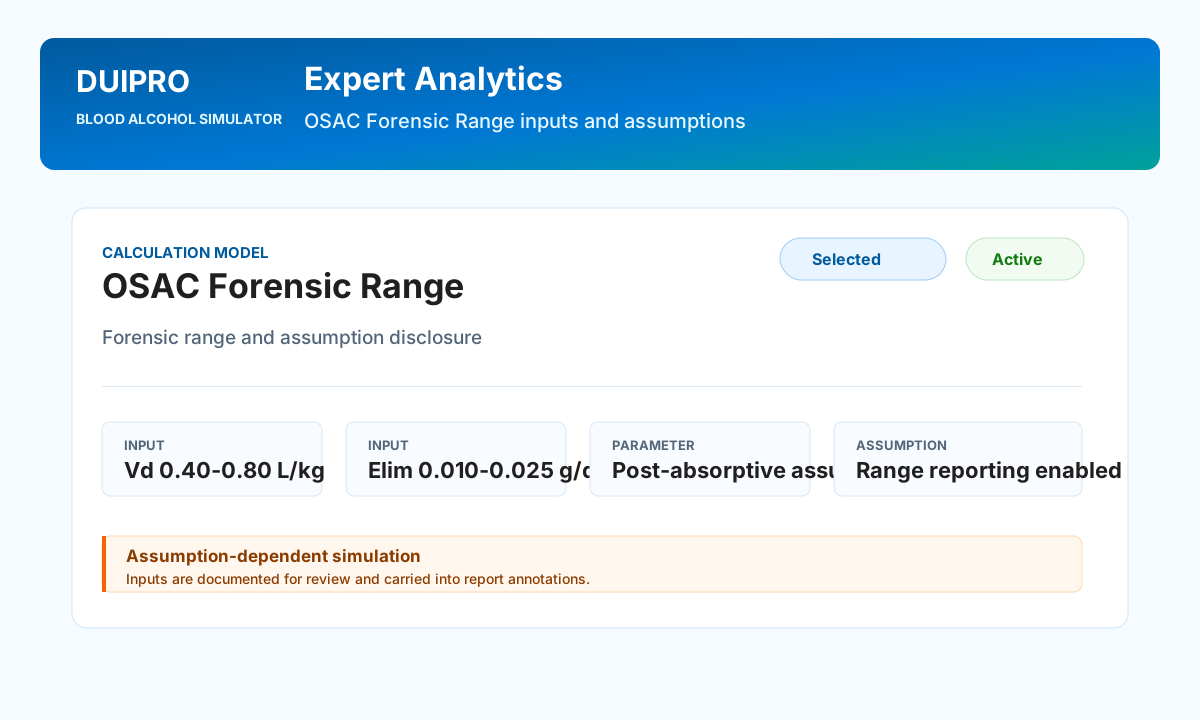
A forensic range model that emphasizes current ASB BPR 122 Vd and elimination ranges, post-absorptive assumptions, uncertainty, and clear reporting rather than a single retrograde value.
Purpose
Why this model exists
The ASB Forensic Range model is designed for users who need a more explicitly forensic framing than a simple default curve. Its purpose is not to replace expert judgment. Its purpose is to force the important assumptions into view: the distribution-volume range, the elimination-rate range, whether the subject was post-absorptive, whether unabsorbed alcohol could matter, and what the model can and cannot say at a given time.
DUI Professional uses this model to help users avoid overclaiming. A retrograde or forward estimate is not made stronger by formatting it as one precise percentage. The ASB-oriented approach asks the user to think in ranges and to keep the report language tied to stated inputs. That is why the model appears as an optional selection rather than the application default.
The model is useful when a reviewer wants to compare the legacy Widmark output with a broader forensic range. The application can display the ASB result on the chart, include it in keypoint values, and enumerate the assumptions in the BAC Model Annotation Appendix. The value is transparency: a reader can see which assumptions created the interval.
Scientific Background
Forensic range assumptions
OSAC guidance emphasizes that alcohol calculations should be framed within their forensic scope. Dose calculations require converting beverage volume and concentration into ethanol mass. DUI Professional uses that dose concept across models, while preserving the drink database and custom drink behavior that users rely on in ordinary simulations.
Distribution volume is treated as a range because the person-specific value is usually not measured in a case file. The active DUI Professional model uses the current ASB BPR 122 fixed general Vd range of 0.45 to 0.81 L/kg. The older OSAC proposed-standard range of 0.40 to 0.80 L/kg is retained only as legacy comparison metadata. A lower Vd generally produces a higher concentration estimate for the same ethanol dose, while a higher Vd generally produces a lower concentration estimate.
Elimination is also treated as a range. ASB BPR 122 uses a common forensic range such as 0.010 to 0.025 g/dL per hour. DUI Professional keeps the source and unit visible because a user should not silently mix guidance ranges. If a report uses ASB assumptions, it should say so. If a report uses UKIAFT comparison assumptions, that should be separately identified.
Absorption is the main caution area. A person may not be post-absorptive at the event time, the test time, or both. Drinking could have occurred close to the event. Food, gastric emptying, drinking rate, and beverage characteristics can affect absorption timing. The model therefore cannot establish post-absorptive status by itself. It can only report what was assumed.
The ASB range model fits the broader forensic principle that uncertainty should be documented. A calculated range is not a guarantee that the true value lies inside the displayed lines. It is a range produced by selected assumptions. Expert review may need laboratory data, specimen details, observation periods, drinking history reliability, and jurisdiction-specific legal context.
Application Workflow
How it appears in DUI Professional
The model is selected from the Calculation Model area of the simulator. Once selected, the card explains that the output is an estimated range and that it does not independently establish post-absorptive status. Subject and scenario inputs remain available, and the chart can overlay the model against the current Widmark midpoint and range.
Drink input works exactly as it does for the rest of the application. Public drink profiles, user-defined custom drinks, partial servings, and per-drink distribution times still determine the ethanol dose and timing. The ASB model does not require a separate drink database. This compatibility matters because users should not have to rebuild a case simply to compare model assumptions.
The Case Evidence section gives the user a place to document post-absorptive status, no-alcohol observation time, specimen type, measured BAC time, measured BAC value, and evidence notes. These entries do not magically remove uncertainty, but they reduce ambiguity. If an observation period supports a post-absorptive assumption, the report should identify that evidence rather than hiding it behind a calculation.
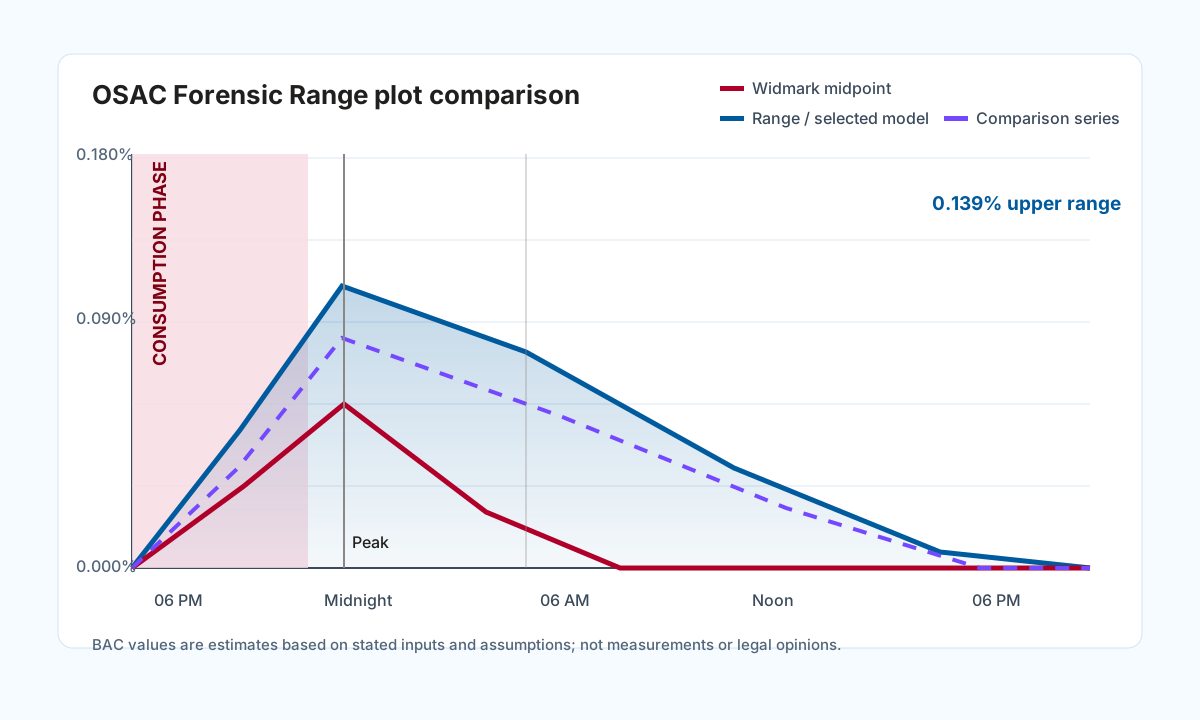
The chart output should be read as a range envelope. The upper, midpoint, and lower values at the keypoint depend on the selected assumptions. When the optional model overlay is on, the user can compare how ASB range behavior differs from the current default line. The chart should remain readable, so users should avoid turning every line on when a report only needs one comparison.
The PDF output should include model name, assumptions, user overrides, units, warnings, and literature basis. The ASB page in Expert Analytics exists so users understand those annotations before generating the report. A report is stronger when a reader can trace the visible range back to the inputs that produced it.
- Select ASB Forensic Range from Calculation Model.
- Confirm the drink list, ABV, volume, and per-drink timing assumptions.
- Review the case evidence controls and document whether post-absorptive status is known, unknown, or assumed.
- Set the keypoint time to the event or specimen time that the analysis is meant to address.
- Export the report only after warnings and assumptions are consistent with the intended professional use.
Chart Interpretation
Reading the range
The ASB range chart should not be read as a bell curve or probability distribution. It is a scenario range generated by selected parameter boundaries. The upper and lower values show how the model changes when different distribution and elimination assumptions are applied. The midpoint is a reference value, not a statement of most likely truth unless the report separately justifies that interpretation.
When the keypoint occurs before absorption is complete, the range can be especially assumption-sensitive. A high test result after the event may not mean the event-time BAC was the same. Conversely, a low modeled event value may depend heavily on the user-entered drinking pattern. The chart is a prompt for professional review, not a substitute for it.
The model is particularly useful for retrograde and forward estimation discussions because it makes the selected rate range visible. If the elapsed time between event and test is long, the chosen elimination range can dominate the result. If the elapsed time is short and drinking is recent, absorption uncertainty may dominate instead.
Users should be careful when comparing ASB range output with Watson or research models. Each model answers a different question with different assumptions. The correct interpretation is not simply that the highest or lowest line wins. The correct interpretation is that the result changes when the scientific assumptions change, and that those assumptions must be disclosed.
Audit Controls
Reducing unsupported assumptions
The ASB Forensic Range model becomes more useful when the user records the evidence that supports or limits the assumptions. A report can state that post-absorptive status is documented only when the record supports that statement. Observation periods, food history, last-drink timing, measured BAC time, specimen type, and post-incident drinking claims all affect how the range should be read.
DUI Professional exposes case-evidence fields so the user can distinguish documented facts from model defaults. A no-alcohol observation interval can support an absorption discussion, but it does not automatically prove every drink was absorbed at the event time. A measured BAC time can anchor a report, but the model still needs an assumption about elimination and absorption between the event and specimen.
The range should also be checked directionally. Lower distribution volume tends to increase dose-derived BAC, while higher distribution volume tends to lower it. Higher elimination can lower forward estimates after peak and can increase retrograde estimates when working backward from a later specimen. The appendix should make these choices visible so a reviewer can reproduce the logic.
When the available facts are thin, the model should say that the output is assumption-dependent. That is not a weakness in the software. It is the scientifically honest result. The user can then decide whether more information is needed before the calculation is used for substantive professional work.
- Enter measured BAC time and specimen type when known.
- Document post-absorptive status only when the case record supports it.
- Keep ASB, legacy OSAC, and UKIAFT ranges separately identified rather than mixing them silently.
- Use the report appendix to preserve Vd, elimination, absorption, and evidence notes.
Reporting
What belongs in the appendix
The BAC Model Annotation Appendix should identify the ASB Forensic Range model, the Vd range, the elimination range, the units, the keypoint values, the peak values, and any post-absorptive or unabsorbed-alcohol warning. If the model is used for comparison only, the report should say that it is a comparison model.
The report should avoid terms such as court approved, definitive, guaranteed, or exact. The appropriate language is that modeled BAC values are estimates based on stated assumptions and inputs. They are not measurements and are not legal or medical opinions.
When case evidence exists, it should be recorded directly. Observation times, specimen type, measured BAC time, measured BAC value, and notes can reduce unsupported assumptions. They do not eliminate the need for professional interpretation, but they improve the audit trail that a reviewer sees in the exported report.
Related Resources
Literature and guidance basis
These authorities support the scientific and forensic framing used in this manual. DUI Professional summarizes the sources for review and does not present the manual as legal or medical advice.
- OSAC 2020-S-0003, Guidelines for Performing Alcohol Calculations in Forensic Toxicology Legacy proposed-standard context for forensic alcohol calculation scope, dose conversion, distribution-volume ranges, elimination-rate ranges, and cautions around absorption and reporting uncertainty.
- ANSI/ASB Best Practice Recommendation 122, First Edition 2024 Current forensic alcohol calculation guidance for assumption-based alcohol calculations, reporting, specimen considerations, and limitations.
- UKIAFT Alcohol Calculation Guidelines v4.4 Alcohol calculation guidance for total body water, elimination ranges, low-BAC caution, and clear reporting of assumptions.
- Jones, A.W., Evidence-based survey of ethanol elimination rates, 2010 Forensic context for ethanol elimination-rate variation and retrograde extrapolation review.
- NIAAA, Alcohol Metabolism Ethanol metabolism, ADH and ALDH pathways, and individual variation in alcohol processing.