Research PK
Two-Compartment Research PK, Norberg-informed
An advanced pharmacokinetic comparison model informed by ethanol PK variability literature, exposed for expert review and education rather than default reporting.
Purpose
Research pharmacokinetic comparison
The Two-Compartment Research PK, Norberg-informed model is an advanced research model for users who need to think beyond a single distribution factor and a single linear elimination slope. It reflects the idea that ethanol pharmacokinetics can involve absorption, distribution between compartments, and elimination variability. DUI Professional exposes it as an expert-review comparison, not as the default simulator.
The model remains labeled Norberg-informed in Expert Analytics for continuity with the advanced model name already exposed in DUI Professional. The page treats it as a research PK comparison unless an exact implemented parameterization is separately documented. Parameter-heavy models can be scientifically interesting but operationally risky if defaults are not authenticated and explained.
In the application, this model helps educate users about distribution phase behavior and sensitivity. It can show how a central compartment, peripheral compartment, transfer terms, and clearance assumptions might change the curve. The purpose is comparison and expert discussion, not routine courtroom back-calculation.
Scientific Background
Compartmental ethanol kinetics
A one-compartment model treats the body as though ethanol is instantly mixed into a single effective distribution volume. That simplification is useful, but it does not describe every pharmacokinetic process. A two-compartment model separates a central compartment from a peripheral compartment and uses exchange terms to describe movement between them.
For ethanol, absorption and distribution can be affected by gastric emptying, food, dose timing, first-pass metabolism, blood flow, tissue water, and individual physiology. A two-compartment structure can be used to explore how distribution delay or exchange could affect the observed concentration-time curve. It also introduces more parameters that must be justified.
The main scientific lesson is variability. Ethanol pharmacokinetic studies differ in design, units, model structure, sampling method, and statistical handling. A parameter set from one context may not be transferable to another. DUI Professional therefore treats this model as research-mode and metadata-documented.
The model can be useful for explaining why the same ethanol dose does not always produce the same curve shape. Absorption timing, peak timing, and terminal behavior can vary. However, the added complexity does not automatically produce better legal analysis. More parameters can also create more ways to be wrong.
Because of that risk, the model should display parameter values and warnings plainly. If the application cannot authenticate defaults, the model should remain a placeholder or expert-review scenario. Expert Analytics gives users the background needed to understand why that restraint is necessary.
Application Workflow
How it is used in DUI Professional
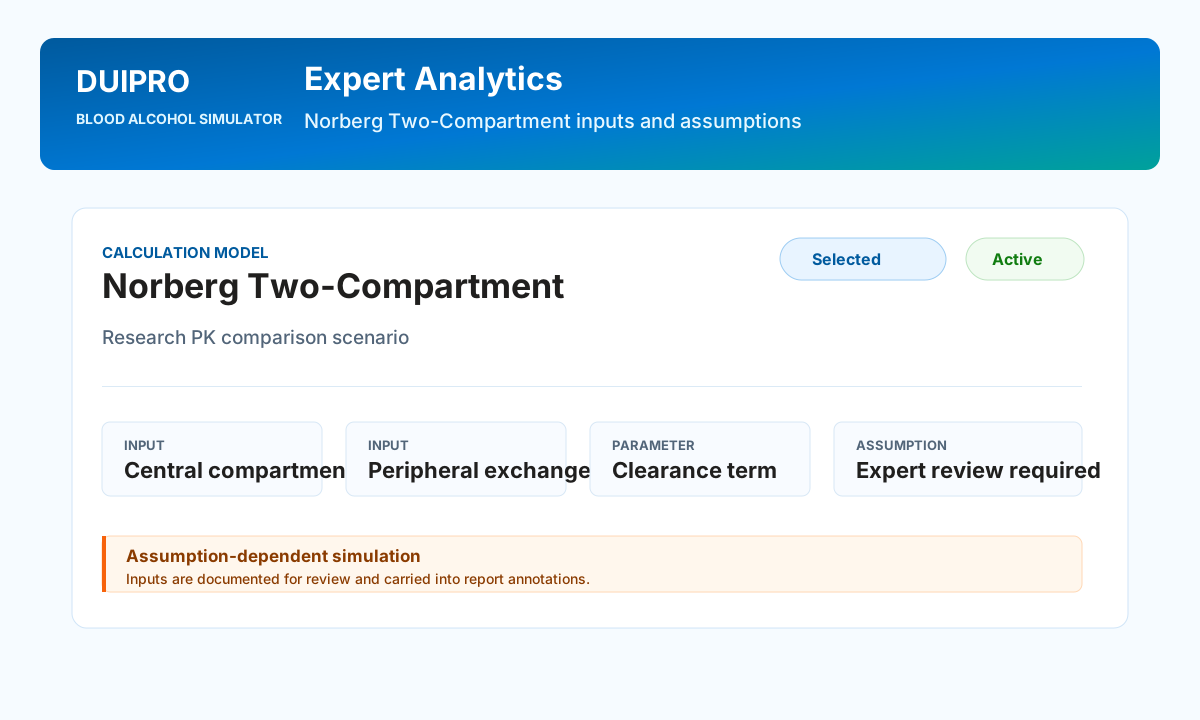
The Norberg-informed research PK model appears in the advanced research area. A user must intentionally enable advanced models before selecting it. This design keeps ordinary simulator work centered on Standard Widmark, ASB range, Watson TBW, and other more practical models while still allowing expert users to explore pharmacokinetic comparisons.
The input panel should enumerate the central compartment term, peripheral exchange term, clearance term, absorption profile, and any source metadata. If a parameter is a sample placeholder, the UI should say so. The model should never hide a parameter-heavy assumption behind a simple label.
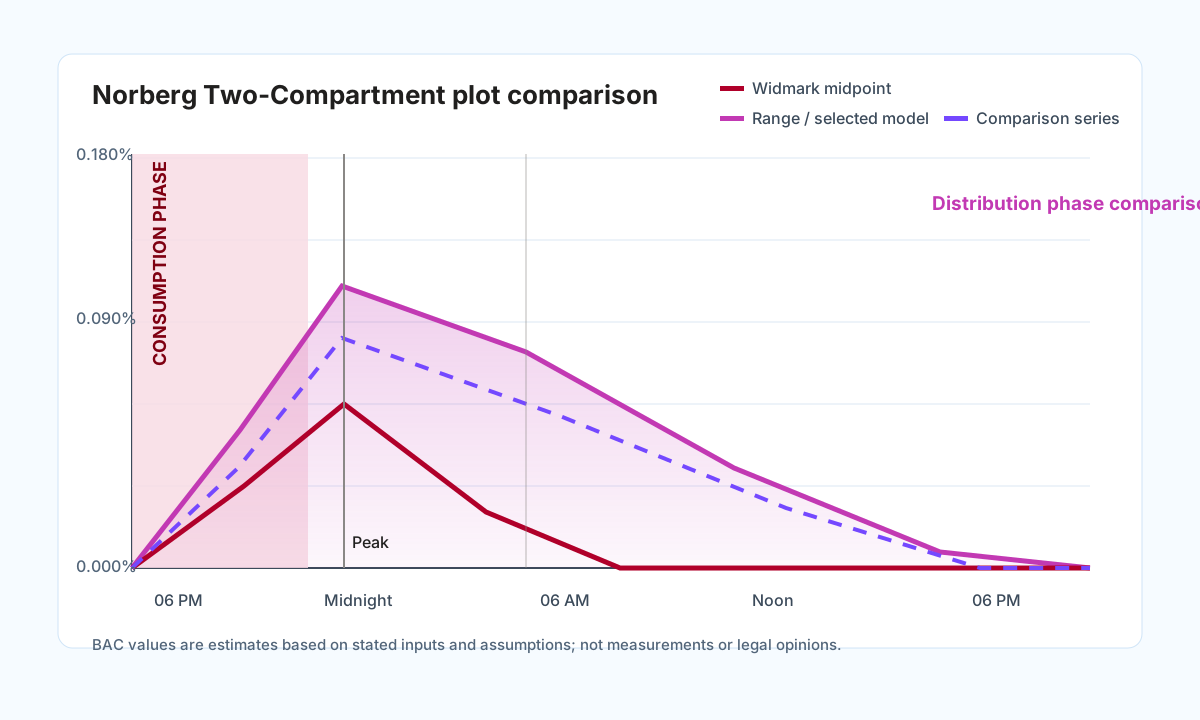
The chart can show how distribution phase behavior changes peak timing and curve shape. A two-compartment curve may rise, bend, or fall differently than a one-compartment line. That does not make it more authoritative by itself. It means the selected parameter set produced a different scenario.
The model is most useful for education, expert review, and sensitivity discussion. It can help a toxicologist or advanced reviewer explain why absorption, distribution, and elimination are not single fixed constants. It can also help attorneys understand why expert testimony may focus on assumptions rather than just arithmetic.
The report should include the model only when expressly selected. If the model is included, the appendix should list every parameter and warning. A reader should be able to tell that this was an advanced comparison and not the default DUI Professional calculation path.
- Enable advanced research models in the Calculation Model section.
- Select Two-Compartment Research PK, Norberg-informed only when expert-review context is appropriate.
- Review central, peripheral, exchange, clearance, and absorption parameters before plotting.
- Use the comparison chart to examine curve shape and keypoint sensitivity.
- Export with the annotation appendix so parameter-heavy assumptions remain visible.
Chart Interpretation
Reading a compartment model
The two-compartment chart should be read as a pharmacokinetic scenario. The line is not merely a smoother version of Widmark. It reflects assumptions about movement between compartments and elimination. If those assumptions change, the line may change in ways that are not intuitive to a non-specialist.
Peak timing is a central issue. A distribution-sensitive model can shift the peak relative to a simpler model. That can matter when the keypoint occurs near the rising limb or shortly after drinking ends. The chart helps visualize that timing sensitivity, but it does not establish which scenario is true.
The model should not be judged by whether it looks more sophisticated. The correct question is whether the parameter set is documented, appropriate to the case facts, and explained in the report. If those conditions are not met, the chart should be treated as educational only.
Comparison with ASB range or Watson output can be helpful, but users should avoid mixing interpretations. ASB range is a forensic range framework, Watson is an anthropometric body-water denominator, and Norberg-informed modeling is pharmacokinetic research. They are different lenses on the same case inputs.
Audit Controls
Compartment parameter transparency
The Two-Compartment Research PK, Norberg-informed model requires the strictest transparency because it contains the most moving parts. A reviewer should be able to identify the central volume, peripheral volume, intercompartmental clearance, renal clearance if used, metabolic elimination terms, absorption bridge, body-water scaling basis, and any uncertainty values. If those values are hidden, the plotted line is not professionally reviewable.
The model should also disclose how it adapts controlled-study parameters to a user-entered subject. Scaling to Watson TBW, weight, or another body-size basis can materially change the result. If Watson inputs are missing and the model falls back to a simpler scaling rule, the report should warn the user rather than making the fallback look equivalent to a measured person-specific parameter set.
A compartment model should be checked for mass-balance behavior. It should not create alcohol after the entered dose is absorbed, should not produce negative BAC, and should not keep a clinically meaningful tail alive solely because of a numerical artifact. These checks are especially important when the chart is smoothed or when the x-axis extends far beyond the elimination period.
The time-step and display controls also matter. A compartment calculation can be sensitive to numerical step size when absorption is rapid or when exchange terms are large. DUI Professional should therefore treat chart smoothing, x-axis extension, and PDF reproduction as presentation choices, not as changes to the underlying model. The report should preserve the calculated keypoint and peak values even when the visual chart is styled for readability and tracked in revision notes in every export.
The practical audit question is whether the model explains a real issue in the case. If the only purpose is to make the chart look more complex, the model should not be used. If the issue involves distribution phase, absorption variability, or sensitivity to advanced pharmacokinetic assumptions, then the model can be a useful expert-review exhibit when every parameter and limitation is disclosed.
- Review compartment volumes, clearance terms, metabolic terms, and absorption bridge before plotting.
- Confirm the body-size or TBW scaling basis used for the subject.
- Check that the curve remains nonnegative and dose-consistent across the displayed timeline.
- Include the appendix whenever this model appears in a report.
Reporting
Expert-review disclosure
The appendix should identify Two-Compartment Research PK, Norberg-informed as an advanced research model. It should list all parameter values, units, source metadata, assumptions, warnings, peak values, keypoint values, and whether the values were authenticated defaults or sample placeholders.
Report language should make clear that the model is intended for comparison and education. It should not say that the two-compartment result is definitive, court-approved, or a replacement for standard forensic range modeling. Expert review is required before the model is used for substantive opinions.
When used responsibly, the model can make the report more transparent by showing how parameter-heavy assumptions affect a BAC curve. When used carelessly, it can create false precision. The Expert Analytics manual is designed to support the first use and prevent the second.
Literature and guidance basis
These authorities support the scientific and forensic framing used in this manual. DUI Professional summarizes the sources for review and does not present the manual as legal or medical advice.
- Jones, A.W., Evidence-based survey of ethanol elimination rates, 2010 Forensic context for ethanol elimination-rate variation and retrograde extrapolation review.
- ANSI/ASB Best Practice Recommendation 122, First Edition 2024 Current forensic alcohol calculation guidance for assumption-based alcohol calculations, reporting, specimen considerations, and limitations.
- NIAAA, Alcohol Metabolism Ethanol metabolism, ADH and ALDH pathways, and individual variation in alcohol processing.