Body water
Watson Total Body Water
An anthropometric total-body-water model using height, weight, sex/body-water basis, and age where the selected Watson equation requires it, with sanity checks, optional composition review, and explicit reporting.
Purpose
Why total body water matters
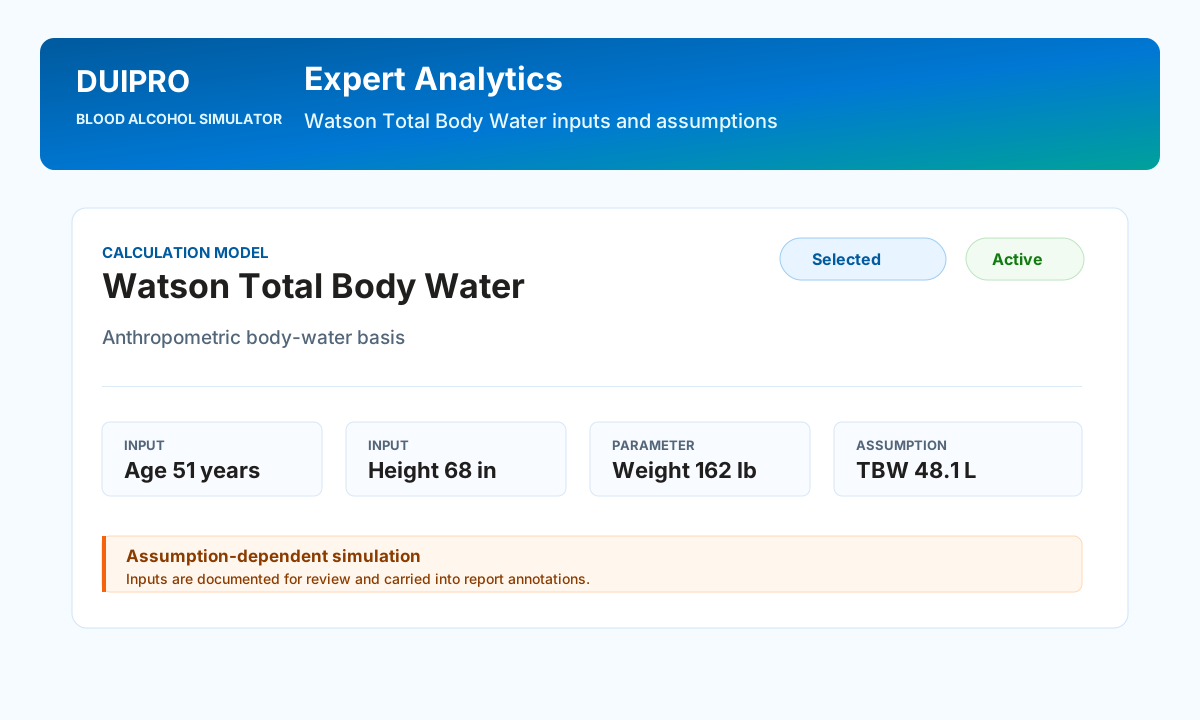
The Watson Total Body Water model is intended for cases where a user wants an anthropometric distribution basis rather than a generic Widmark r assumption. It estimates total body water from the published Watson equations, then uses that estimate to build a BAC scenario. The male equation uses age, height, and weight; the female equation uses height and weight and does not use age. The model is optional because it needs inputs that a basic simulation may not have.
DUI Professional treats Watson TBW as an active model only when the required inputs are present and physiologically plausible. The phrase invalid TBW is not silently reported means the application should not display a calculated-looking BAC when the underlying total body water estimate is missing, out of plausible bounds, or unsupported by the entered inputs.
The model is useful for transparent comparison. It lets a reviewer ask whether the anthropometric body-water approach produces a materially different peak or keypoint estimate from the default Widmark workflow. It also gives the report a clearer input trail because height, weight, body-water basis, age when used, and body-composition assumptions are displayed in the model controls and annotations.
Scientific Background
Anthropometric TBW estimation
Watson, Watson, and Batt published widely used total body water equations in 1980 based on simple anthropometric measurements. The equations are not a direct laboratory measurement of a particular person. The male equation estimates total body water from age, height, and weight. The female equation estimates total body water from height and weight. DUI Professional presents the model as an assumption-dependent estimate for that reason.
A regression sample is retained in the code and report audit: age 51 years, height 68 inches, and weight 162 pounds yields about 40.85 L using the Watson male equation and about 34.49 L using the Watson female equation. A 48.1 L value for that same sample would be inconsistent with the published Watson equations.
Total body water matters because ethanol distributes primarily into body water. A TBW-based denominator can be conceptually attractive in alcohol calculations, and later forensic literature has discussed why total body water may be preferable to a generic volume-of-distribution factor. That does not mean every case has enough data to use TBW responsibly.
The model requires height, weight, age, and sex/body-water basis. The application should not infer missing age or height from another screen, and it should not use gender identity as a hidden calculation proxy. The label sex/body-water basis is intentionally explicit: it tells the user which body-water equation basis is being applied and leaves room for documented assumptions.
Physiological sanity checks are important. Guidance such as UKIAFT cautions that implausibly low total body water values should not be used. If the calculated TBW is outside expected limits, the application should show a cannot calculate notice instead of returning a misleading BAC. That approach is more conservative and more transparent.
Body composition controls can help explain sensitivity, but they do not replace direct measurement. A body-fat percentage override can be used as a documented composition scenario, especially when BMI alone is not informative. The report should still say whether Watson equations or composition-adjusted assumptions were used and whether direct TBW measurement was available.
Application Workflow
How DUI Professional applies it
The Watson card appears in the Calculation Model section. When selected, it asks for subject inputs that may not be required by Standard Widmark. The page shows age, height in inches, weight in pounds, sex/body-water basis, BMI, and optional body-fat percentage controls when those controls are enabled.
The model should become usable only after the required values are present. If the simulator already has weight from the Basic Settings panel, that value can be used. If height and age are missing, the user must enter them. This makes the UI more demanding, but it prevents an anthropometric model from pretending to know information that has not been provided.
When the body-fat override is active, the result should be treated as a composition scenario. The application can show BMI calculated from height and weight, but BMI itself does not directly measure water. The body-fat slider and numeric value give the user a way to document an alternate composition assumption. The report should show both the default and override basis when applicable.
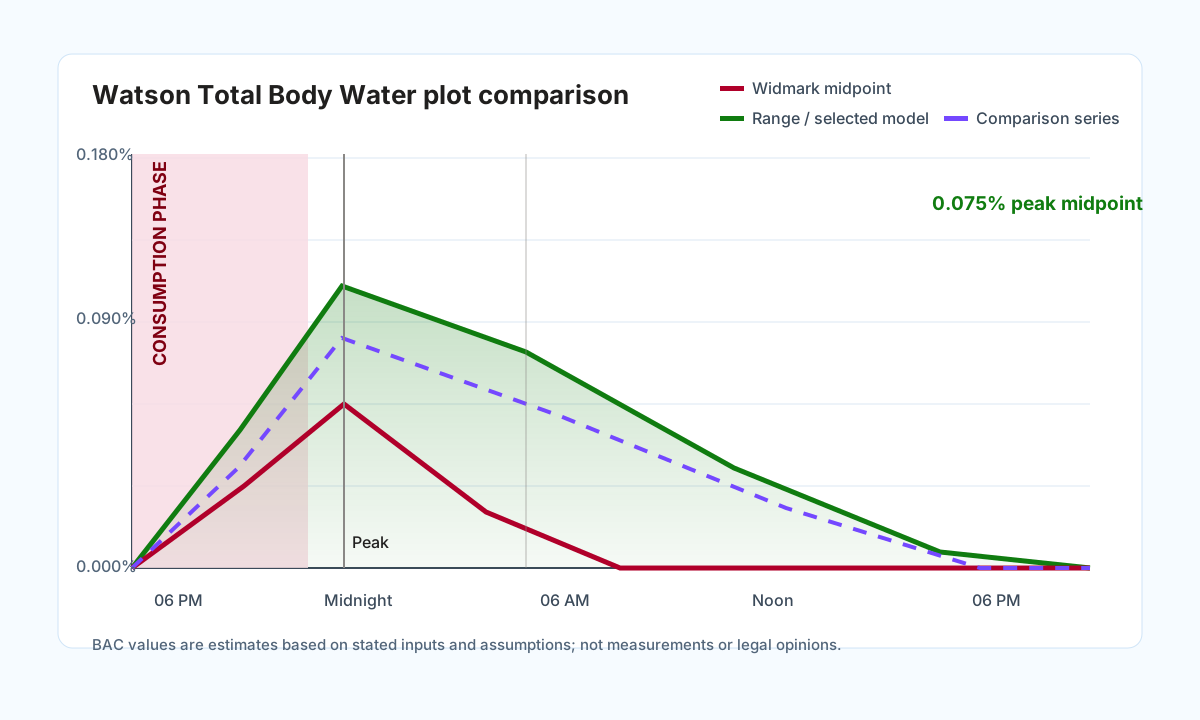
The chart overlay lets the user compare Watson TBW output with the current simulator output. Differences can occur because the denominator is constructed differently. The user should review whether the anthropometric inputs are accurate before interpreting the difference. A wrong height, age, weight, or basis can produce a polished but unhelpful comparison.
The model result panel should explain peak midpoint, peak range, keypoint midpoint, keypoint range, warnings, and units. If warnings are absent, the report can say no model-specific warnings were reported. If warnings are present, they should be displayed on screen and in the PDF annotation appendix.
- Enter or verify weight, height, age, and sex/body-water basis before selecting Watson TBW.
- Review BMI as a derived screening value, not as a direct body-water measurement.
- Use the body-fat percentage override only when the assumption is documented and relevant to the scenario.
- Confirm that the model result panel reports success before relying on the chart overlay.
- Export the report with the annotation appendix so TBW inputs and assumptions remain visible.
Chart Interpretation
Reading a TBW overlay
A Watson TBW overlay is best read as an alternate denominator scenario. It may produce a higher or lower estimate than the default model depending on the total body water estimate and blood-water fraction assumptions. The overlay is not automatically more correct simply because it uses more inputs.
If the Watson line diverges sharply from the Widmark line, the first review step is data quality. Check height, weight, sex/body-water basis, age when the male equation is used, body-fat override status, and drink timing. A chart can expose sensitivity, but it cannot validate the truth of the inputs.
The keypoint value is often more important than the peak. A case question may concern driving time, crash time, workplace event time, or test time. The Watson model can show how TBW assumptions affect that specific point on the curve, which is more useful than only comparing peak percentages.
The model should be avoided when inputs are missing or physiologically implausible. The correct UI behavior is to withhold calculation and explain the missing or invalid data. A blank or warning state is better than a number that looks precise but rests on an unsupported body-water estimate.
Audit Controls
Anthropometric data checks
Watson TBW is data-hungry compared with the default model. Age, height, weight, and sex/body-water calculation basis must be present because the equation cannot estimate body water from a name or a gender label. DUI Professional deliberately uses calculation-basis language so the user understands that this is a body-water assumption, not a hidden identity proxy.
BMI and body-fat override controls add another review layer. BMI is calculated from height and weight to help the user recognize possible anthropometric limits. Body-fat percentage can be used as a documented composition scenario when available, but it should not be guessed casually. If the override is enabled, the report needs to show the percentage, fat-free mass hydration fraction, calculated TBW, and uncertainty range.
Physiological sanity checks are essential. A calculated TBW below the caution thresholds should not be reported as though it were valid. A very high BMI or unusual body composition should prompt review because anthropometric equations may be less reliable outside the populations for which they were derived. The right behavior is to warn or withhold calculation when the input set is not defensible.
The final audit question is whether Watson adds useful information for the case. If the body data are reliable, Watson can provide an alternate denominator that may be more transparent than a generic distribution factor. If the body data are weak, the model can create the appearance of precision without improving the analysis.
- Verify height, weight, sex/body-water calculation basis, and age when the male equation is selected before selecting Watson.
- Use body-fat override only when the percentage is documented or intentionally modeled as a scenario.
- Check BMI and TBW validity warnings before reading the keypoint output.
- Confirm the appendix lists TBW, uncertainty range, blood-water fraction, BMI, and override status.
Reporting
Transparency in reports
The BAC Model Annotation Appendix should identify the Watson Total Body Water model, the equations or basis used, the anthropometric inputs, BMI, body-fat override status, calculated TBW, uncertainty range, blood-water fraction, peak values, and keypoint values. This detail is the reason the model belongs in an expert analytics workflow.
The report should distinguish Watson TBW from Standard Widmark. If both appear on the same chart, the legend and appendix should say which line is the current baseline and which line is the selected optional model. A reviewer should not have to guess which curve came from which assumption set.
The report should avoid implying that an anthropometric equation measures the individual subject. It estimates. If a direct TBW measurement or more specific forensic analysis is available, that information may change the review. DUI Professional provides scenario modeling, not a medical or legal conclusion.
Literature and guidance basis
These authorities support the scientific and forensic framing used in this manual. DUI Professional summarizes the sources for review and does not present the manual as legal or medical advice.
- Watson, Watson, and Batt, Total body water volumes, 1980 Anthropometric equations for estimating total body water from age, height, weight, and sex-specific calculation basis.
- Maskell et al., Total body water in forensic blood-alcohol calculations, 2020 Forensic comparison of total-body-water approaches and volume-of-distribution approaches for blood-alcohol calculations.
- UKIAFT Alcohol Calculation Guidelines v4.4 Alcohol calculation guidance for total body water, elimination ranges, low-BAC caution, and clear reporting of assumptions.
- ANSI/ASB Best Practice Recommendation 122, First Edition 2024 Current forensic alcohol calculation guidance for assumption-based alcohol calculations, reporting, specimen considerations, and limitations.
- OSAC 2020-S-0003, Guidelines for Performing Alcohol Calculations in Forensic Toxicology Legacy proposed-standard context for forensic alcohol calculation scope, dose conversion, distribution-volume ranges, elimination-rate ranges, and cautions around absorption and reporting uncertainty.