Legacy default
Standard Widmark
The preserved DUI Professional default model for dose, distribution, absorption timing, elimination, keypoint review, and backward-compatible report output.
Purpose
What the model is for
The Standard Widmark model is the default calculation path in DUI Professional because it reflects the workflow that existing users already understand: identify the ethanol dose, distribute that dose through a body-water related factor, account for absorption timing, subtract elimination over time, and display a BAC curve tied to a case timeline. The application intentionally preserves this behavior so saved simulations and ordinary user expectations do not change simply because more advanced options are now available.
In practice, the model is used to establish a baseline simulation. A user enters subject information, adds drink profiles or custom drinks, defines the consumption window or per-drink distribution, chooses a keypoint time, and reviews the lower, midpoint, and upper estimates. The output is not presented as a measurement. It is a structured estimate based on the stated drink inputs, body variables, and timing assumptions selected by the user.
The reason to keep Widmark at the center is not that it answers every forensic question. It does not. Its value is that it gives a transparent first layer of analysis. A reviewer can see how much alcohol was modeled, what body-weight and distribution assumptions were used, what elimination rate was selected, where the peak occurred, and what the estimated BAC was at the selected event or test time.
Scientific Background
Dose, distribution, absorption, and elimination
Widmark-style alcohol calculations begin with dose. DUI Professional converts beverage volume and alcohol concentration into ethanol amount, then uses that amount in the timeline model. A U.S. standard drink reference is commonly described as about 14 grams or 0.6 fluid ounces of pure ethanol. That standard drink reference helps a user understand serving equivalence, but the simulator still uses the actual ABV and serving volume entered for each drink.
Distribution is the most visible assumption in the Widmark model. The familiar r factor approximates the fraction of body mass into which ethanol distributes. It is not a direct person-specific measurement. It is an assumption that can be varied, and that variation is why a range is more appropriate than a single point estimate when the calculation is being used for professional review.
Absorption is handled as a timeline assumption, not as a claim that every drink instantly becomes blood alcohol. DUI Professional can show a consumption phase and allow absorption timing to affect when BAC rises, peaks, and falls. When per-drink distribution is enabled, the model can reflect asymmetric drinking patterns rather than forcing every drink into an even linear pool over the entire drinking window.
Elimination is modeled as a rate over time. For ordinary Widmark-style work, a linear elimination assumption is common, but the selected rate remains a user-facing assumption. Literature and forensic guidance repeatedly emphasize that elimination rates vary between people and contexts. DUI Professional therefore shows lower, midpoint, and upper estimates when range controls are enabled.
Uncertainty is not an afterthought. Alcohol calculations can be affected by drink strength, pour volume, body mass, distribution assumption, absorption completeness, elimination rate, and the precision of event times. The Standard Widmark page in Expert Analytics explains those dependencies so users understand why an apparent precise percentage should not be treated as a laboratory result.
Application Workflow
How DUI Professional uses it
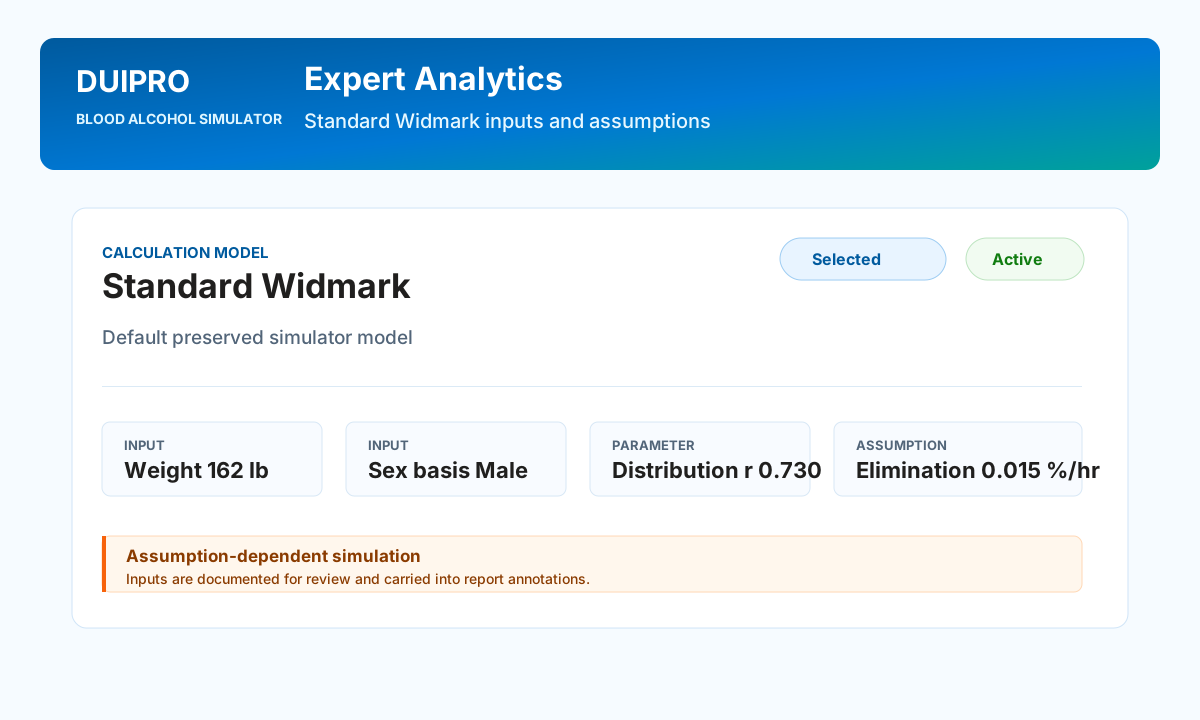
In the simulator, the user begins by entering subject and case information. Weight, sex/body-water calculation basis, stomach contents, elimination classification, notes, and event times shape the default Widmark curve. The values are displayed in the chart and carried into the report narrative so the model can be audited later.
Drink selection is connected to the public drink database and private custom drink library. A user can add a beer, wine, spirit, liqueur, or mix profile, adjust serving fractions, and define an exact volume and ABV when the facts require it. This matters because Widmark dose calculations are sensitive to the ethanol amount. A small change in ABV or volume can change the curve and keypoint values.
The Drink Distribution timeline extends the legacy model by letting individual drinks occur at different times and over different consumption lengths. A front-loaded pattern can peak earlier than an evenly pooled pattern. A back-loaded pattern can make the keypoint fall during rising BAC. Stacked drinks can make the chart visibly show intensive consumption over a short interval. These are still assumptions, but they are better documented assumptions.
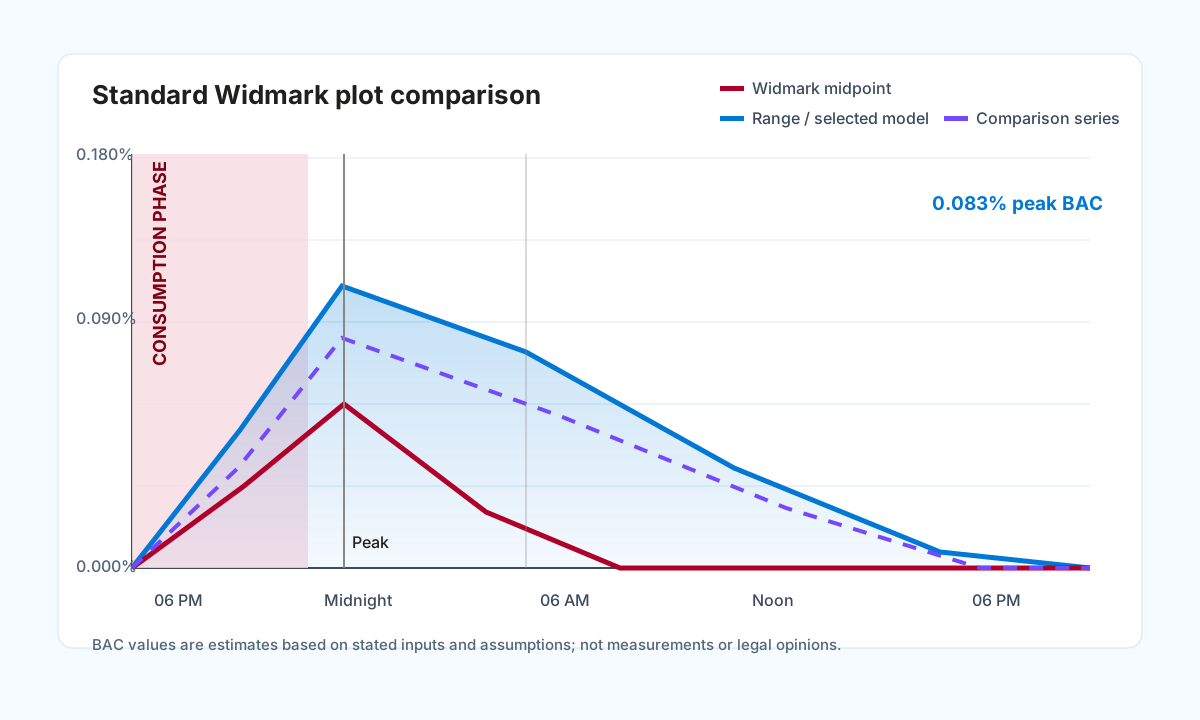
The chart shows the modeled curve, peak marker, keypoint line, consumption phase, and optional range lines. When a user drags the keypoint slider, the corresponding keypoint values update. When the timeline or drink list changes, the curve changes. This immediate feedback is important because the workflow is exploratory: the user can test whether the scenario is plausible under the inputs available.
Reports preserve the Standard Widmark result as the current simulator output. If optional models are not selected, the report remains familiar. If optional comparison is selected, the annotation appendix can identify that Widmark was the baseline and then enumerate the additional models, inputs, warnings, and literature basis used for comparison.
- Start with the known case facts: subject weight, reported drinking period, event time, test time, and drink information.
- Add drinks from the public database or private custom drink library, then adjust serving fractions or exact values as needed.
- Set the keypoint to the event that matters, such as driving time, crash time, workplace event time, or collection time.
- Review the midpoint curve first, then enable lower and upper range lines if the question requires uncertainty review.
- Use report notes to document what facts were known, what was assumed, and what remains disputed.
Chart Interpretation
Reading the plot
A Widmark plot should be read as a timeline. The vertical axis reports BAC in percent weight/volume or g/dL-equivalent terms used by the application. The horizontal axis reports clock time. The consumption phase is shown so the reviewer can see whether the keypoint occurs during drinking, shortly after drinking, or later in the elimination phase.
The midpoint line is the expected model output under the selected midpoint assumptions. The lower and upper lines show the range implied by the selected distribution and elimination settings. These range lines should not be treated as confidence intervals unless the report states a specific statistical method. They are scenario boundaries for the assumptions used in the simulator.
The peak marker shows when the modeled BAC reaches its maximum. This is especially important when an event happens before the peak. If the event occurs on the rising side of the curve, the later test value may be higher than the modeled event-time value. That is the practical reason the chart exists: timing can matter as much as dose.
If the chart includes a selected optional model overlay, the Widmark midpoint remains the baseline. The overlay should be read as a comparison, not as an automatic replacement. A disagreement between lines is a cue to inspect inputs and assumptions, not a reason to pick whichever line is more helpful to one side.
Audit Controls
Checking the assumptions before export
The most important quality-control step for the Standard Widmark model is to compare the chart against the facts that created it. The drink list should match the reported beverage type, ABV, volume, and serving fraction. The consumption window should match the witness statement or case record. If the Drink Distribution timeline is enabled, each drink should have a defensible start time and duration rather than merely being placed to create a preferred curve.
The subject inputs should be reviewed with the same discipline. Weight should be the best available case value, not a convenient estimate. Sex/body-water basis should reflect the calculation assumption being used, and notes should document why that assumption was selected when it is disputed or uncertain. Stomach contents and elimination classification should be treated as assumptions unless supported by case evidence.
The keypoint deserves a separate check. Many report errors occur because the selected event time is not the actual time being discussed in the legal or training question. DUI Professional makes the keypoint visually prominent because the modeled BAC at the relevant time is usually more important than the peak value. Before export, the user should confirm the keypoint label, clock time, and time zone context.
Finally, the reviewer should inspect the report language. A clean report does not hide uncertainty. It states what was entered, what was assumed, what range was produced, and what remains outside the model. That audit discipline is what turns a simple Widmark calculation into a professional simulation record.
- Confirm every drink row against the case source before relying on the displayed dose.
- Confirm the keypoint time and label before reading the modeled event-time BAC.
- Review subject inputs and absorption assumptions for unsupported defaults.
- Export the annotation appendix when optional models or unusual assumptions are present.
Reporting
How the report should frame it
A report should state that modeled BAC values are estimates based on stated assumptions and inputs. They are not measurements and are not legal or medical opinions. This language is deliberately direct because it prevents a model output from being mistaken for a laboratory result or a court-approved conclusion.
The report should identify the selected model, calculation date, drink assumptions, subject inputs, timing assumptions, keypoint values, peak values, and warnings. If any input is missing or uncertain, the report should say so. If the model was used only as a baseline for comparison, the appendix should make that relationship clear.
When the Standard Widmark model is used by itself, the report can remain relatively compact. When it is used beside ASB forensic range, Watson total body water, Michaelis-Menten, or Norberg-informed research PK scenarios, the report should become more explicit. The point of Expert Analytics is to make that added detail understandable before a user exports the PDF.
Literature and guidance basis
These authorities support the scientific and forensic framing used in this manual. DUI Professional summarizes the sources for review and does not present the manual as legal or medical advice.
- OSAC 2020-S-0003, Guidelines for Performing Alcohol Calculations in Forensic Toxicology Legacy proposed-standard context for forensic alcohol calculation scope, dose conversion, distribution-volume ranges, elimination-rate ranges, and cautions around absorption and reporting uncertainty.
- ANSI/ASB Best Practice Recommendation 122, First Edition 2024 Current forensic alcohol calculation guidance for assumption-based alcohol calculations, reporting, specimen considerations, and limitations.
- Jones, A.W., Evidence-based survey of ethanol elimination rates, 2010 Forensic context for ethanol elimination-rate variation and retrograde extrapolation review.
- NIAAA, Understanding Alcohol Drinking Patterns Standard drink and drinking-pattern context for alcohol education.